
- News
- City News
- delhi News
- Delhi: Residents in war of words over ownership of Tughlaq-era tomb
Trending
This story is from August 7, 2021
Delhi: Residents in war of words over ownership of Tughlaq-era tomb
Accusations and counter-accusations are being exchanged over the Lal Gumbad, a Tughlaq-era structure in the neighbourhood of south Delhi’s Panchsheel Park. The residents of the abutting Sadhna Enclave allege that a family is encroaching on the complex, while the claimed co-owner of the land insists the plot has been a property of the family for many decades and they had only now cleared it of garbage.
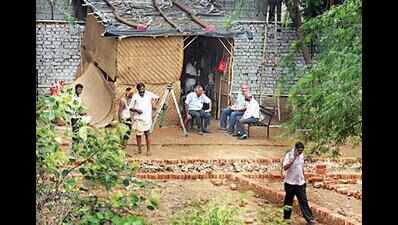
ASI said it had received complaints related to Lal Gumbad and construction, and would start an inquiry
The residents of the abutting Sadhna Enclave allege that a family is encroaching on the complex, while the claimed co-owner of the land insists the plot has been a property of the family for many decades and they had only now cleared it of garbage.

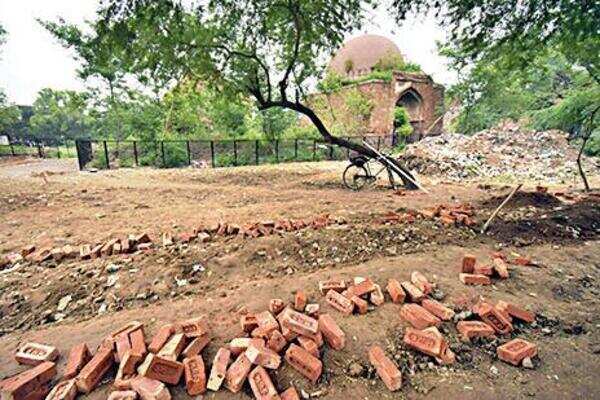
Land near Lal Gumbad, a Tughlaq-era tomb in Malviya Nagar which was awarded one Bigha by a Delhi court in November to a private ownership who are now doing construction work on the surface on Monday. (Photo: Tarun Rawat)
Also known as Rakabwala Gumbad, or the tomb of iron rings, the red sandstone structure was built in 1397 as the tomb of the 14th century Sufi saint, Sheikh Kabir-ud-din Auliya, a disciple of Shaikh Raushan Chirag-i-Delhi. The domed structure, despite being a protected monument, is, the local residents claim, “a hub of anti-social activities”.
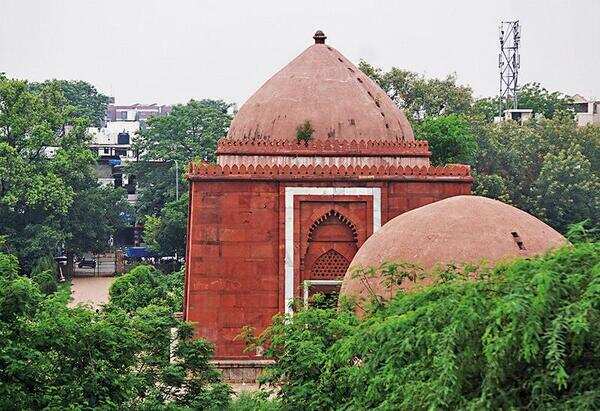
However, the residents of Sadhna Enclave are now more concerned about the structure itself.
While a Delhi court decreed in November last year that the plot of land measuring 1 bigha 13 biswas had been in the possession of the Jain family since 1978, the residents claim steel fencing has been put up around the land and construction activities are under way in violation of the Ancient and Historical Monuments and Archaeological Sites and Remains Act, 1951, which prohibits anyone, including the owner or occupier of a protected area, from constructing anything within the protected area or carrying on mining, quarrying, excavating, blasting or any operation there without the permission of the central government.
The hubbub began in June when garbage was removed from the complex and bricks were laid, leading the Sadhna Enclave RWA to believe this was the first step in erecting a permanent structure on the Lal Gumbad complex.
Sudhir Gupta, RWA president, claimed, “Our colony shares a common wall with the plot on which Lal Gumbad and its cluster monuments stand. We are very concerned that the integrity of the historical structure is being compromised because the ground is being flattened after a fence was put up around it. Trees are also being chopped down and clearly construction work has begun in violation of laws.”
While Gupta added that a JJ colony had sprung up in the area adjoining the Lal Gumbad, Sunil Jain, co-owner of the land, rebutted all charges of encroachment. He told TOI, “The land has belonged to our family for several decades and we only cleaned up the rubble and the garbage there. In fact, I am creating vegetable patches on the land.” He claimed that the Ancient and Historical Monuments Act permitted crop cultivation in protected areas.
As for the RWA’s allegations of fence erection and tree felling, Jain maintained, “No tree has been harmed and the fence has been there for many years. If we hadn’t put up the fence for security, the slum colony would have encroached on our land.”
Speaking to TOI, an Archaeological Survey of India official said, “We have received complaints related to the Lal Gumbad and the allegations of construction on the complex. We will start an inquiry into the matter soon.”
In response, Jain said that he would “fully cooperate with the authorities” in the probe because “we are not doing anything illegal”.
End of Article
FOLLOW US ON SOCIAL MEDIA










Photostories

Hot Picks
TOP TRENDING
Popular Categories
Hot on the Web
Top Trends
India Qualifying ScenarioBaba Siddique NewsPakistan Cricket TeamRussell WilsonsSpacex StarshipRahul DravidWho was Baba SiddiqueBabar AzamNTA SWAYAM July RegistrationLawrence BishnoiAmazon LayoffsTaylor SwiftManagement Colleges of IndiaTop Medical Colleges of IndiaTop Engineering Colleges of IndiaTop Pharmacy Colleges of IndiaLive Cricket Score
Trending Topics
Diwali WishesNara RohithDussehra WishesVettaiyan OTT ReleaseVettaiyan CollectionVettaiyan ReviewNatasa StankovicDevara CollectionBigg Boss 18Deepika PadukoneShraddha KapoorRatan Tata Passed AwayJigra Movie ReviewVettaiyan Movie ReviewSwatantrya Veer SavarkarDussehra 2024Star Health Hacker DemandedViral MemesUltimate Football Codes October 2024Wordle Answer
Living and entertainment
Latest News
10 deadliest snakes in Australia and know their venom toxicityOver 70 injured at Devaragattu Banni stick festival during Dussehra celebrationsPassion missing, players don’t want to work hard, lament former intl’sHow tomato, potato, onion influence food inflationBiker’s death ignites village fury in Odisha's Boudh, massive traffic jam on NH-57Reliance Jio sends 'complaint letter' to telecom minister Jyotiraditya ScindiaWomen's T20 World Cup: Why India need Pakistan victory over New Zealand to secure semifinal berthSpaceX's fifth Starship test flight achieves historic booster catchCops probing Bishnoi gang's links to Siddique's murderKrushna Abhishek shares a heartwarming post for mama Govinda; says 'jab body mein adha blood supremely talented actor Govinda ka ho...'Papankusha Ekadashi 2024: Date, Parana Time, Puja Rituals and SignificanceKenya's Ruth Chepngetich breaks women's world record at Chicago MarathonAI’S OppenheimerFormer Pakistan PM Imran Khan's sisters shifted to Jhelum jail on judicial remand'I truly believe ... ': What police said after third assassination attempt on Donald TrumpBaba Siddique murder case: Slum dispute that sparked ED inquest to be part of probeFor 20 years, Thar getting more rain than normalSpiritual fervour marks Bagh Savari festival held at Tirumala
Copyright © 2024 Bennett, Coleman & Co. Ltd. All rights reserved. For reprint rights: Times Syndication Service